We will start by introducing roles, followed by definitions, and later use diagrams and schemas to illustrate the purpose and relationships between these concepts in separate posts.
It is important to understand that many roles have evolved due to how modern IT environments are designed and operated today. However, many terms are still rooted in fundamental concepts, and understanding these fundamentals is essential to fully grasp why things work the way they do.
The roles listed below are presented to show their place within the broader IT ecosystem. While all of them are important, the main focus of this content will be on DevOps and Infrastructure-related roles, as these are the areas most closely aligned with my experience.
Roles for the 2026 base on trend and decisions
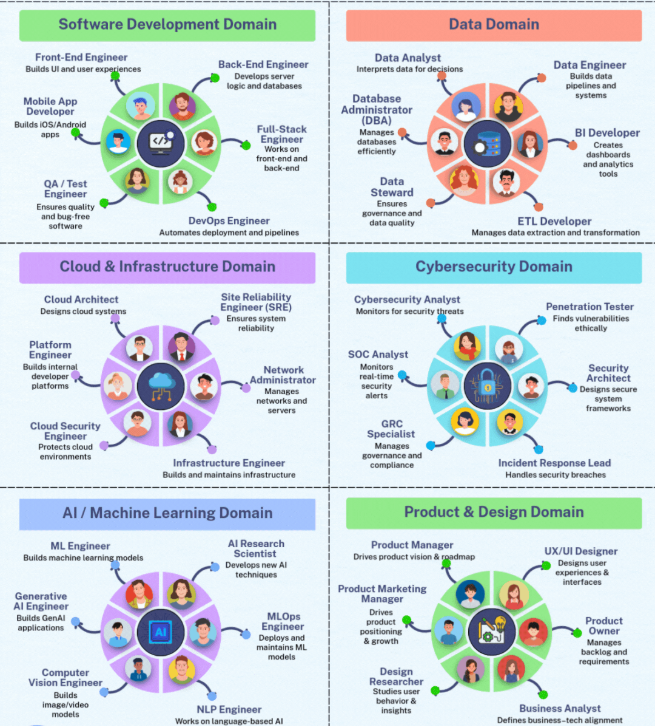
1. Software Development Domain
This domain covers roles responsible for building and maintaining applications and systems.
Roles include:
Front-End Developers, Back-End Developers, Full-Stack Developers, Mobile Developers, QA Engineers, and DevOps Engineers.
These roles power the applications, platforms, and products we use every day, transforming business requirements into working software.
2. Data Domain
This domain focuses on collecting, managing, processing, and interpreting data to support business and technical decisions.
Roles include:
Data Analysts, Data Engineers, BI Developers, Database Administrators (DBAs), Data Stewards, and ETL Developers.
They ensure data is reliable, accessible, and usable across the organization.
3. Cloud & Infrastructure Domain (Main Focus)
This domain forms the technical backbone of modern IT systems and is a primary focus of this page.
Roles include:
Cloud Architects, Site Reliability Engineers (SREs), Platform Engineers, Infrastructure Engineers, Network Administrators, and Cloud Security Engineers.
These roles design, build, operate, and secure the platforms and infrastructure that applications and data depend on.
4. Cybersecurity Domain
This domain is responsible for protecting systems, data, and users from increasingly complex security threats.
Roles include:
Cybersecurity Analysts, Penetration Testers, SOC Analysts, Security Architects, Incident Response Leads, and GRC Specialists.
They focus on prevention, detection, response, and compliance.
5. AI & Machine Learning Domain
This domain focuses on building intelligent systems that learn from data and automate complex tasks.
Roles include:
Machine Learning Engineers, AI Researchers, MLOps Engineers, NLP Engineers, Generative AI Engineers, and Computer Vision Engineers.
These roles represent the future of advanced automation and data-driven intelligence.
6. Product & Design Domain
This domain bridges technology and business, ensuring products deliver value to users and organizations.
Roles include:
Product Managers, UX/UI Designers, Product Owners, Product Marketers, Design Researchers, and Business Analysts.
They shape user experience, define product vision, and align technical work with business goals.
Platform enginering
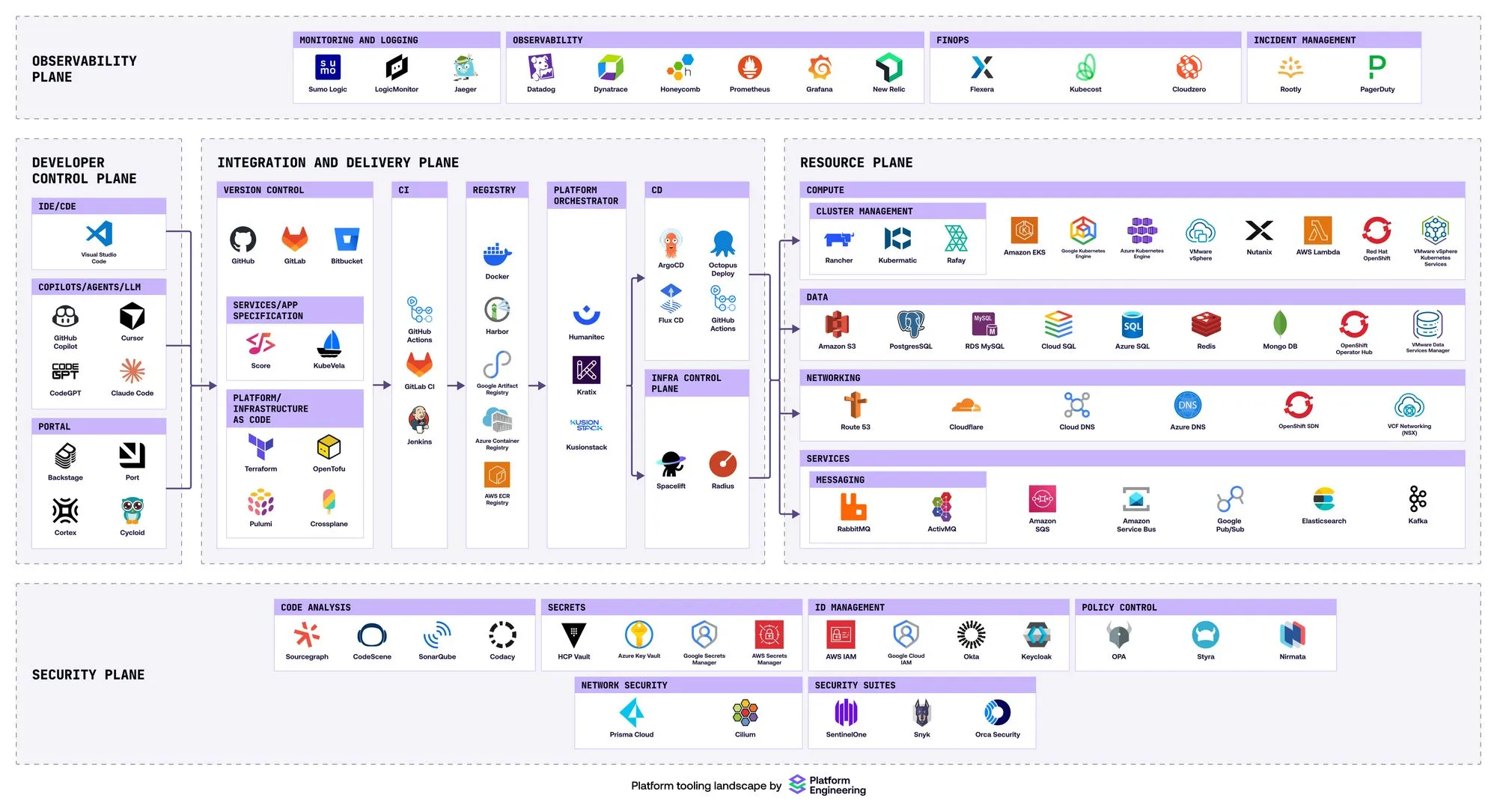
Link to : https://platformengineering.org/platform-tooling
Platform Engineering is a specialized role that supports DevOps teams by providing and managing the environments needed for development, testing, and deployment. This includes provisioning infrastructure, configuring tools, and automating processes according to project requirements. Traditionally, system administrators, database administrators, and network engineers handled parts of these responsibilities, but Platform Engineering goes beyond that by bridging gaps and streamlining workflows. The role requires solid intermediate knowledge of infrastructure, CI/CD pipelines, cloud services, and automation tools. This setup enables DevOps engineers to focus on building and deploying applications while ensuring proper system management and segregation of duties.
DevOps

IT Operator / DevOps Operator is responsible for maintaining, monitoring, and supporting IT infrastructure and environments used by development and operations teams. This includes managing servers, cloud resources, networks, and application deployments, as well as troubleshooting issues and ensuring system stability. The role also involves executing automated scripts, monitoring performance metrics, and assisting in continuous integration and deployment (CI/CD) processes. IT Operators work closely with DevOps and Platform Engineering teams to ensure that environments are reliable, secure, and aligned with operational requirements, allowing developers to focus on building and delivering applications efficiently.
- Virtualization & Containerization
- Immutable Infrastructure – Replace servers instead of patching.
- Blue-Green Deployment – Switch environments to reduce downtime.
- Rolling Updates – Gradual deployment for minimal disruption.
- Microservices – Modular apps split into independent services.
- Serverless – Event-driven cloud functions.
- Container Orchestration – Kubernetes, Docker Swarm.
- Service Mesh – Manages service-to-service traffic (Istio, Linkerd).
- Networking & Security
- SDN (Software Defined Networking) – Abstract network control, automation-friendly.
- VLAN (Virtual LAN) – Segment networks for security/performance.
- Routing – Determine traffic paths across networks.
- BGP – Core Internet routing protocol.
- MPLS – Enterprise traffic routing.
- MAC Security – Hardware-based access control.
- IPv4 vs IPv6 – Legacy vs modern addressing.
- VPN (Virtual Private Network) – Secure remote traffic.
- ZTN (Zero Trust Network) – Never trust, always verify security model.
- IPsec/WireGuard – Encrypted network tunnels.
- Firewall & Security Rules – Host and perimeter protection.
- Network Diagnostics – Ping, traceroute, packet captures.
- Load Balancing – Distribute traffic across servers.
- API Gateway – Control and secure API traffic.
- Storage & Data Management
- SAN (Storage Area Network) – Centralized, high-performance storage.
- NAS (Network-Attached Storage) – File-level storage, easy access.
- Backups – Protect critical data.
- Backup Retention Policies – Define duration of stored backups.
- Disaster Recovery – Restore systems after incidents.
- Disaster Recovery Testing – Validate DR plans.
- Capacity Planning – Forecast storage and resource needs.
- Single Source of Truth – Centralized config/documentation.
- Storage Quotas & Management – Allocate disk space efficiently.
- DevOps Methodologies & CI/CD
- CI (Continuous Integration) – Merge code frequently.
- CD (Continuous Delivery/Deployment) – Automated code delivery.
- CI vs CD – Integration vs deployment focus.
- Pipeline as Code – CI/CD pipelines in YAML/DSL.
- Automated Testing – Unit, integration, E2E.
- Version Control – Git, SVN, track code changes.
- Branching Strategies – GitFlow, trunk-based.
- Rollbacks – Revert failed deployments.
- Feature Flags – Toggle features safely.
- Environment Variables Management – Keep configs flexible.
- Infrastructure Testing – Validate IaC before deployment.
- Blue-Green & Canary Releases – Reduce risk in production.
- Artifact Repositories – Store builds (Artifactory, Nexus).
- Immutable Infrastructure – Consistent deployable servers.
- Automation & Configuration
- Infrastructure as Code (IaC) – Manage infra with code (Terraform, Ansible).
- Configuration Management – Maintain consistent system state.
- Automation Scripts – Bash, Python, Go.
- Self-Healing Systems – Auto-restart or replace failed components.
- Secret Management – Store passwords/keys securely (Vault).
- Observability – Metrics, logs, traces for troubleshooting.
- Metrics – Quantitative performance measurements.
- Logs – Record events/errors.
- Traces – Follow requests across services.
- Monitoring – Ensure system health (Prometheus, Grafana, ELK).
- Compliance as Code – Automate security/compliance checks.
- Chaos Engineering – Test resiliency by injecting failures.
- Telemetry – Collect system data for monitoring.
- IT Operations & Administration
- System Administration – OS, users, permissions.
- Network Management – Switches, routers, IPs, VLANs.
- Patch Management – Keep OS/applications updated.
- Incident Handling – ITIL processes, root cause analysis.
- Problem Management – Solve recurring issues.
- DNS Administration – Map domain names to IPs.
- VPN Configuration – Secure remote access.
- Performance Tuning – Optimize servers, networks, storage.
- Cloud Access Management – Users, roles, permissions in cloud.
- Logs & Audit Trails – Compliance and troubleshooting.
- Job Scheduling – Cron, Task Scheduler, automate tasks.
- High Availability – Ensure uptime via redundancy.
- Change Management – Controlled updates with minimal risk.
- Incident Reports & Documentation – Maintain knowledge base for support.
- User Access Control – Manage permissions, MFA, RBAC.